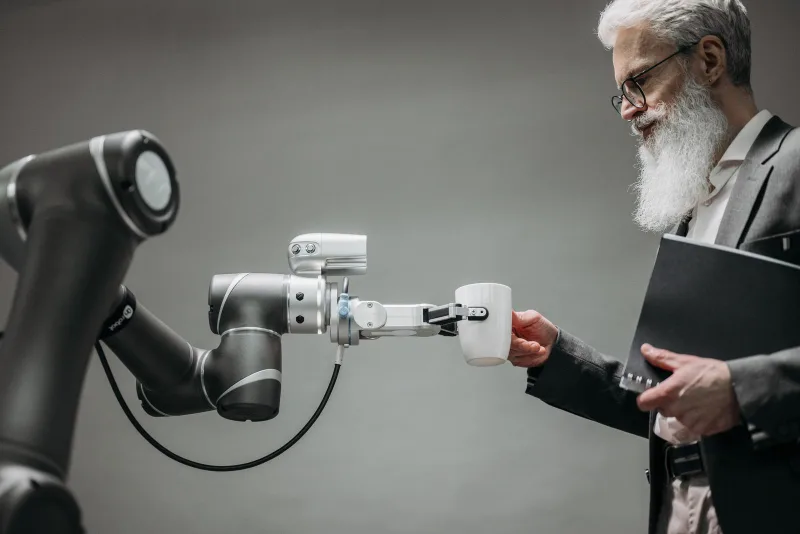

Every year the security industry publishes trend lists, and most of them are the same ten items rearranged. This year, an independent review graded the consensus list against actual evidence and found something unusual: eight of the ten big trends hold up, and the two that do not are instructive. Autonomous AI defense, the idea that AI agents can run security operations on their own, flunked its benchmark badly. Everything else, from AI-driven attacks to identity-first defense, is backed by real data.
Here are the seven trends that actually matter in 2026, what is driving each one, and what they mean whether you run a company or just want to keep your own accounts safe. For the incident side of the story, see our explainers on the Ontario courts cyberattack and rogue AI coding agents.
Key takeaways
- Agentic AI is the number one trend: Gartner ranks agentic AI oversight as 2026's top cybersecurity concern, as autonomous agents multiply inside enterprises faster than anyone can track.
- Identity is the control plane: 77 percent of organizations call identity and access their biggest cloud risk, and non-human identities now outnumber human ones in many environments.
- Zero trust is operational now: continuous verification has replaced perimeter defense as the working model, driven by AI attacks that move faster than human response teams.
- The skills gap is structural: 63 percent of organizations report staff shortages and 59 percent report critical skills needs, up 44 percent year over year.
- AI defense is assistive, not autonomous: 25 AI models ran 1,080 investigations on an independent benchmark in August 2026 and none passed.
Trend 1: AI agents become the attack surface
The defining security story of 2026 is not a new malware strain. It is the arrival of AI agents inside the enterprise: software that does not just answer questions but invokes tools, executes workflows, and takes actions across business applications. Gartner has projected that 40 percent of enterprise applications will embed task-specific AI agents by 2026, and many organizations are already running agents their identity teams have never catalogued.
That creates risk in two directions. Inside the organization, every agent is a new access point with credentials, permissions, and the ability to act. The quieter version of the same problem is shadow AI: employees using unapproved AI tools and browser extensions, the 2026 heir to shadow IT. It is a major data-leak vector, with data policy violations tied to generative AI doubling in 2025 and continuing to rise. Outside, attackers use AI to find weaknesses faster and scale attacks far beyond human capacity: autonomous phishing campaigns built from scraped corporate data, AI-assisted vulnerability discovery, and deepfake-enabled social engineering. One industry analysis notes adversaries now coordinate attack steps in 22 seconds instead of eight hours.
The defensive response is agentic too. At its Next '26 event, Google Cloud showed triage agents processing over 5 million alerts while cutting analysis time from 30 minutes to 60 seconds, alongside new controls for prompt injection and non-human identities. The emerging picture is a war of the bots: AI agents defending banks and infrastructure against AI agents attacking them, with humans shifting from doing to governing.
Trend 2: Identity becomes the control plane
"Identity is the new perimeter" has been said for a decade. In 2026 it finally became operationally true, because the perimeter itself dissolved. Traditional VPNs are collapsing as identity-based access and zero trust network access become the primary defenses, and the identity problem has expanded: it is no longer just humans logging in, but AI agents, APIs, service accounts, and machine-to-machine workloads, all demanding credentials.
The numbers explain the urgency. In SentinelOne's 2026 cloud security statistics, 77 percent of organizations named identity and access issues their biggest cloud-native risk, and 69 percent said tool sprawl and visibility gaps hinder their teams. Non-human identities now outnumber human ones in many environments, and without strict governance they accumulate excessive permissions, so a single compromise can cascade across cloud setups.
The practical consequence: security budgets are shifting from network boxes to identity governance, continuous authentication, and AI-augmented anomaly detection. If your organization still treats identity as an IT admin function rather than a security priority, 2026 is the year that stops being tenable.

Trend 3: Zero trust grows up
Zero trust, the principle of never trusting and always verifying, spent years as a marketing slogan. In 2026 it became an operational necessity, because AI-powered attacks can compromise credentials and move laterally through networks faster than any human response team can react. Operating on assumed trust is no longer a defensible posture.
Modern zero trust implementation rests on four pillars: identity-first security with behavioral biometrics and contextual risk scoring; micro-segmentation that walls networks into isolated zones; continuous monitoring that baselines normal behavior and flags anomalies; and least-privilege access enforced dynamically rather than by static roles. It requires real architectural change, but the alternative is worse.
Trend 4: Ransomware industrializes further
Ransomware did not go away in 2026; it reorganized. The big syndicates fragmented into dozens of smaller, harder-to-track crews, white-label ransomware services let affiliates rebrand attacks to dodge attribution, and extortion tactics expanded beyond encryption to pure data-theft shakedowns. Attack volumes hit records even as the share of victims paying ransoms fell to historic lows.
The economics are shifting under defenders' feet in a useful way: refusing to pay is working at the population level, even as the organizations that do pay get hit harder than ever. Ransomware-as-a-service and the defenses that actually stop it deserve their own full treatment, which we publish as a companion piece.
Trend 5: Deepfakes go mainstream in fraud
Synthetic media crossed from curiosity to operational threat this year. An estimated 8 million deepfakes now circulate online, up from 500,000 two years ago. Voice clones need as little as three seconds of audio for a convincing match. Deepfake-enabled fraud surged 3,000 percent in North America in a single year, and one deepfake video call produced a $25.6 million loss, the largest known social engineering theft of its kind.
For individuals, the defense is disarmingly low-tech: verify through a separate channel before any financial action, because only an estimated 0.1 percent of people can reliably spot a fake. How to spot deepfake scams, and what actually stops them, is covered in our companion guide.
Trend 6: The skills gap gets structural
Headcount grew in 2025, but the skills problem got worse. ISC2's survey of 16,029 cybersecurity professionals found 63 percent of organizations report a staff shortage, down slightly from 68 percent in 2024, but 59 percent now report a critical or significant skills need, up 44 percent year over year. Three in ten cannot find talent with the right skills at all. The most wanted skill is AI at 41 percent, followed by cloud security and risk assessment.
The consequences land on existing staff: 88 percent of practitioners report at least one negative consequence from the shortage, including overlooked procedures and employees handed tasks beyond their training. This is the structural reason AI-assisted defense is being adopted so fast: there simply are not enough humans, so the humans that exist need machine-speed help.

Trend 7: Post-quantum readiness and regulatory teeth
Two slower-burning trends deserve attention. First, post-quantum cryptography moved from theory to planning, as organizations with long-lived sensitive data start inventorying where quantum-vulnerable encryption lives. Harvest-now-decrypt-later attacks make this a present-tense problem for some sectors even though cryptographically relevant quantum computers are not here yet.
Second, regulatory enforcement sharpened. In Canada, the federal financial regulator OSFI published AI risk guidance in March 2026 noting that most financial institutions globally are reconsidering voice-verification systems because of AI voice cloning. A National AI Council now shapes AI policy, and incidents like the Ontario courts breach keep public-sector security in the headlines. Compliance is becoming a security driver, not just a paperwork exercise.
Practical next steps
For businesses:
- Inventory your AI agents. You cannot secure what you have not catalogued. List every autonomous tool with access to your systems, who owns it, and what it can touch.
- Put identity first. Enforce multi-factor authentication everywhere, audit non-human identities and service accounts, and prune excessive permissions.
- Assume breach in architecture. Micro-segmentation and tested offline backups limit the blast radius when, not if, something gets through.
- Train for the new lures. Phishing training built for 2020-era emails will not catch AI-generated spearphishing or deepfake calls. Update scenarios annually.
For individuals:
- Turn on MFA everywhere, preferably app-based or hardware keys rather than SMS.
- Use a password manager and unique passwords per site. Our 1Password vs Bitwarden comparison covers Canada's own contender.
- Verify before you trust. Any urgent financial request, by voice, video, or message, gets confirmed through a separate channel. No exceptions.
- Keep devices updated. Most mass-exploitation campaigns still target known, patched vulnerabilities.
The bottom line
The 2026 threat landscape is defined by a single shift: both attackers and defenders now operate through autonomous agents, and the contest is increasingly machine-speed. That makes identity the decisive battleground, zero trust the working model, and skilled humans the scarcest resource. The good news is that the fundamentals have not changed: MFA, backups, patching, and verification stop the vast majority of attacks, AI-powered or not. The organizations and individuals that master the basics while governing their AI exposure will be fine. Those chasing shiny AI defenses while neglecting the basics will learn the expensive way that attackers go for the unlocked door, not the reinforced wall.
Sources
- BetaNews, "Adapting to AI agents, growing risks and perimeter focus: identity predictions for 2026": https://betanews.com/article/adapting-to-ai-agents-growing-risks-and-perimeter-focus-identity-predictions-for-2026/
- WebProNews, "The Hidden Shield: How Zero Trust and Cloud Giants Guard Enterprises Against AI-Driven Threats": https://www.webpronews.com/the-hidden-shield-how-zero-trust-and-cloud-giants-guard-enterprises-against-ai-driven-threats/
- Que.com, "Zero Trust Architecture Rebuilt for the AI Threat Era": https://que.com/zero-trust-architecture-rebuilt-for-the-ai-threat-era/
- Simbian, "Cybersecurity Trends Graded: 25 Models, 0 Passed": https://simbian.ai/blog/cybersecurity-trends-graded
- IT Brew, "Headcount grew in 2025, but skills shortages remain an issue": https://www.itbrew.com/stories/2025/12/05/headcount-grew-in-2025-but-skills-shortages-remains-an-issue
- Undercode Testing, "Identity Is The New Perimeter, Again": https://undercodetesting.com/identity-is-the-new-perimeter-again-securing-humans-machines-and-ai-agents-in-a-zero-trust-world-video/
- National Cybersecurity, "AI-Powered Cybersecurity Trends for 2026": https://nationalcybersecurity.com/everything-you-need-to-know-ai-powered-cybersecurity-trends-for-2026-hacking-cybersecurity-infosec-comptia-pentest-ransomware/
Quick answers
Frequently asked questions
01
What is the biggest cybersecurity trend of 2026?
Agentic AI oversight. Gartner ranks it the number one cybersecurity trend for 2026: autonomous AI agents are proliferating inside enterprises faster than identity teams can track them, and securing both the agents and the humans behind them is now the central challenge.
02
What is zero trust security?
Zero trust is the principle of never trusting and always verifying. Every access request is treated as potentially hostile until proven otherwise, using continuous checks of identity, device health, location, and behavior. In 2026 it has moved from marketing buzzword to operational necessity.
03
Are AI agents a security risk?
Yes, in two directions. Inside companies, AI agents create new access points and ungoverned tools that can leak data. Externally, attackers use AI to find weaknesses faster and scale attacks far beyond human capacity. Defenders also use AI agents for threat hunting and alert triage.
04
Is there really a cybersecurity skills shortage?
Yes. An ISC2 survey of 16,029 professionals found 63 percent of organizations report a cybersecurity staff shortage, and 59 percent report a critical or significant skills need, up 44 percent year over year. AI skills top the wish list at 41 percent.
05
What is shadow AI?
Shadow AI is employees using unapproved AI tools and extensions, the 2026 version of shadow IT. It is a major data-leak vector: data policy violations tied to generative AI doubled in 2025 and kept rising, according to SentinelOne's 2026 cloud security statistics.
06
How is Canada responding to these threats?
Canada's financial regulator OSFI published AI risk guidance in March 2026, and a National AI Council now advises on AI policy. High-profile incidents like the Ontario courts cyberattack have also pushed public-sector security up the agenda.
07
Will AI replace human security analysts?
Not yet. In August 2026, 25 AI models ran 1,080 investigations on an independent cyber defense benchmark and none passed. AI is a force multiplier for analysts, triaging alerts in seconds instead of minutes, but human judgment still governs the response.
08
What should a small business do about these trends?
The fundamentals still stop most attacks: multi-factor authentication everywhere, tested offline backups, prompt patching of internet-facing systems, and phishing-resistant habits. You do not need an AI security platform to fix the basics most attackers exploit.